
Why Home Prices Can Be Rising, Falling, and Flat at the Same Time

Why Home Prices Can Be Rising, Falling, and Flat at the Same Time

You've probably heard that home prices are cooling off. And that's true – nationally. But zoom in on individual markets across the country, and the picture looks completely different depending on where you are.
Some areas are still seeing solid price growth. Others have gone flat. A few have actually dipped slightly negative. So, what's causing all of that variation?
How Housing Inventory Is Driving Home Price Trends Across the U.S.
Here's the simple version:
- When there are more homes for sale, buyers have options.
- More options mean less competition.
- Less competition means sellers can't push prices as high.
On the flip side, when inventory is tight, buyers are competing over a small pool of homes, and that pushes prices up.
That dynamic is playing out right now in a really visible way across the country.
Markets where inventory has climbed back to, or above, normal pre-pandemic levels are seeing prices flatten or fall slightly. Markets where inventory is still well below those 2019 benchmarks are still seeing prices rise. As Lance Lambert, CEO of ResiClub, puts it:
"Home prices are still climbing a little year-over-year in many regions where active inventory remains well below pre-pandemic 2019 levels, such as pockets of the Northeast and Midwest.
In contrast, some pockets in states like Texas, Florida, and Colorado — where active inventory exceeds pre-pandemic 2019 levels by a solid clip — are seeing modest home price pullbacks or flat pricing."
How Housing Inventory and Home Prices Compare Across the U.S.
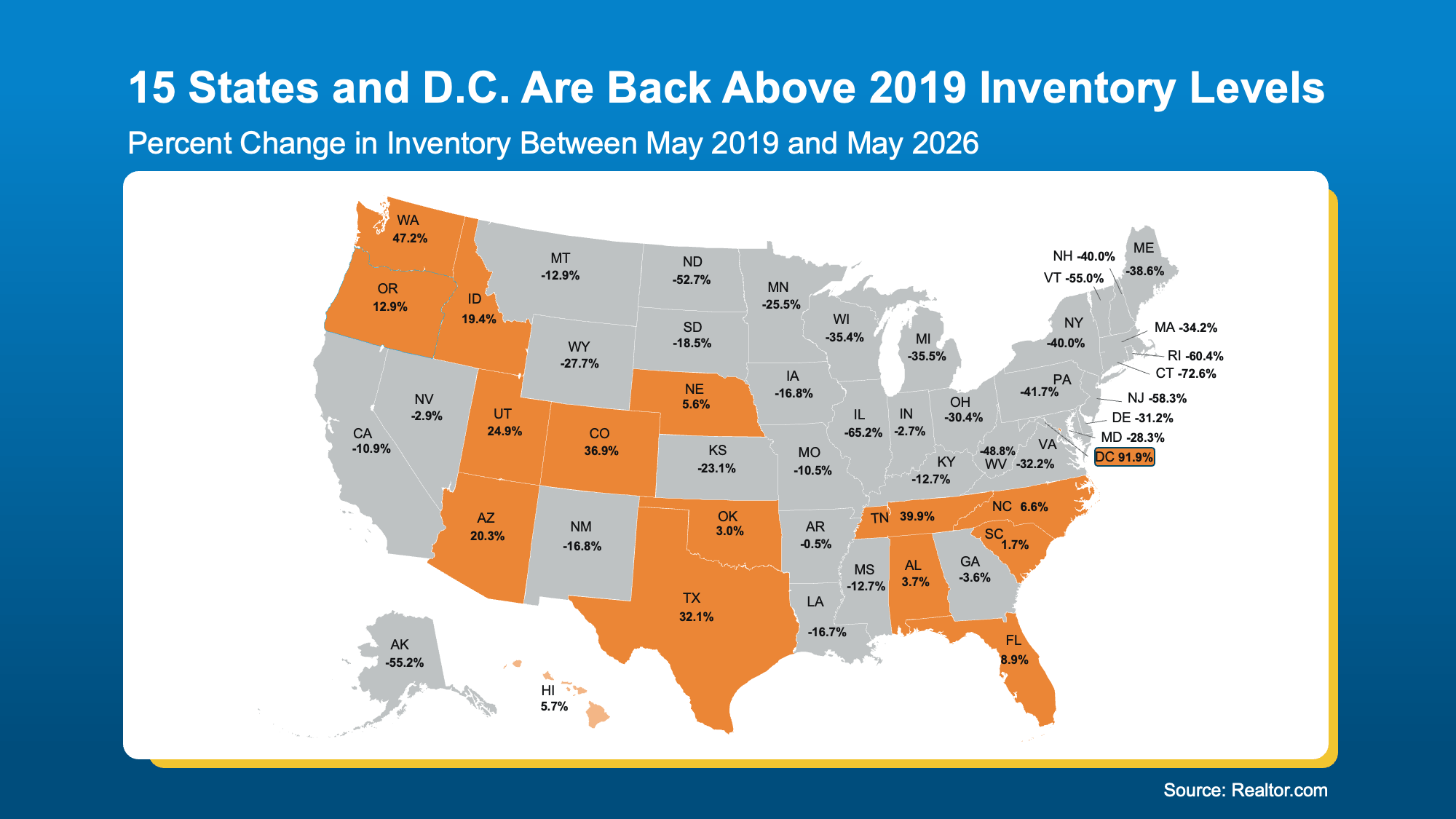
Take a look at where inventory stands today compared to 2019. In most places (the states in gray below), inventory still falls short of where we were back then. And that’s exactly why prices are climbing, albeit moderately, in the vast majority of states.
But you’re probably more interested in where prices are falling a bit, since that’s what is making headlines. So, let’s prove out how much inventory affects prices in those spots.
According to Realtor.com, 15 states and Washington, D.C. are now back above pre-pandemic inventory levels, and some by a wide margin (see the orange in the map below):
Now, let’s look at the latest Federal Housing Finance Agency (FHFA) data to see what's happened to home prices in those same states over the past year (again, you’ll want to focus on the orange in the next map).
See how those line up pretty closely with the areas seeing more homes for sale today?
The overlap illustrates the strong relationship between housing inventory and home price trends across many markets.
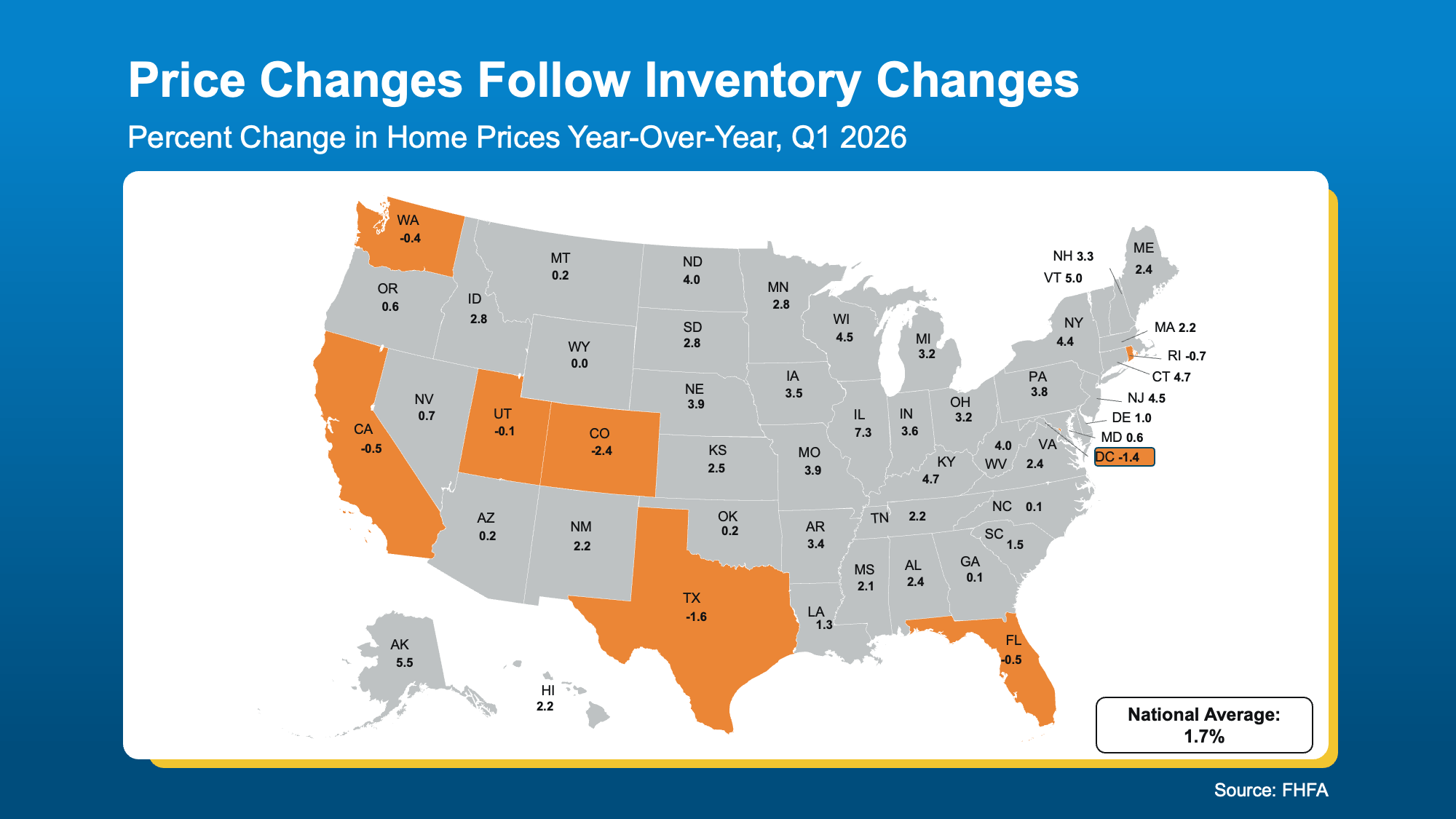
The national average of 1.7% price growth is accurate, but it's an average of two very different stories happening at the same time – the few areas experiencing mild declines and the overwhelming majority that are still seeing prices rise.
What This Means If You’re Buying or Selling
If you're a buyer, the market you're shopping in matters a lot right now. In places like Texas, Colorado, or Florida, you may have real negotiating power – more choices, less competition, and sellers who are more motivated to make a deal. In tighter markets like much of the Northeast, you're still likely facing a lot of competition.
If you're a seller, pricing strategy is everything. In markets where inventory has risen, overpricing is one of the fastest ways to linger on the market and eventually sell for less than you would have with the right price from day one. In markets where inventory is still low, you're in a strong spot, but getting your price right still matters if you want to attract serious buyers quickly. Either way, that's where a local real estate agent earns their keep.
Why Local Housing Market Trends Matter More Than National Headlines
When it comes to home prices, local market conditions matter more than national headlines. While national housing market trends provide valuable context, every market is different. That's why understanding what's happening in North San Diego County real estate is so important if you're planning to buy or sell a home.
Whether you're looking for homes for sale in North San Diego County, exploring Carlsbad homes for sale or Vista homes for sale, or you're searching for an experienced Escondido real estate agent, having accurate local market insights can help you make confident, informed decisions.
Helpful resources to get started:
- Find out what your home is worth with a Home Value Estimate.
- Browse the latest Homes for Sale.
- View our Market Snapshot for the latest local housing market trends.
- Estimate your monthly payment with our Mortgage Calculator.
- Contact us to discuss your real estate goals and create a strategy that's tailored to today's North San Diego County housing market.
Still have questions? Here are answers to some of the most common questions about housing inventory and home prices.
Frequently Asked Questions
Why are home prices rising in some markets but falling in others?
Home prices can vary from one market to another because local housing market conditions are different. One of the biggest factors is housing inventory. In markets with more homes for sale, buyers typically have more choices, which can reduce competition and contribute to slower home price growth or modest price declines. In markets where inventory remains limited, home prices have generally continued to rise because buyer demand exceeds the available supply.
How does housing inventory affect home prices?
Housing inventory refers to the number of homes available for sale in a market. When inventory increases, buyers often have more options, which can reduce competition among buyers and influence home price trends. When inventory remains limited, competition for available homes may increase, which can contribute to upward pressure on home prices. Inventory is an important factor, but mortgage rates, local economic conditions, and buyer demand also play a role.
Why don't national housing market trends match every local market?
National housing market data represents an average across many different markets. Local factors such as housing inventory, buyer demand, employment, new construction, and local economic conditions can contribute to home price trends that differ from the national average. That's why national headlines may not reflect what's happening in every city or neighborhood.
About Patricia Villanueva, North San Diego County Real Estate Agent
Patricia Villanueva is a North San Diego County real estate agent serving buyers and sellers throughout Escondido, Carlsbad, Oceanside, Vista, San Marcos, and the surrounding communities. With a data-driven approach and in-depth local market knowledge, Patricia Villanueva helps clients understand housing market trends, navigate changing market conditions, and make informed real estate decisions with confidence.
Whether you're buying your first home, selling your current property, or simply exploring the market, you'll find valuable resources, including homes for sale in North San Diego County, home valuation tools, local market updates, neighborhood information, and expert real estate guidance designed to help you achieve your goals.
Learn more about Patricia Villanueva, browse the latest homes for sale, explore current market reports, or get in touch to discuss your real estate goals.
Disclaimer: This article is for informational purposes only and should not be considered financial, legal, tax, or investment advice. Housing market conditions and real estate trends can change over time and vary by location. Always consult current local market data and qualified professionals before making real estate decisions.
Categories
- All Blogs (178)
- 55+ Communities (1)
- Buyer & Seller Resources (36)
- Buyers (9)
- Condo Living (1)
- First-Time Buyers (47)
- Foreclosure Trends (2)
- Foreclosure Updates (2)
- Home Buying Tips (76)
- Home Equity (1)
- Home Improvement (1)
- Home Selling Tips (59)
- Homebuyer Tips (48)
- Homeowner Tips (30)
- Housing Market Insights (32)
- Housing Market Trends (59)
- Market Updates (28)
- Mortgage Education (16)
- Mortgage Insights (13)
- Mortgage Rates (3)
- New Construction (6)
- Pricing Strategy (3)
- Real Estate Advice for Buyers (42)
- Real Estate Advice for Sellers (41)
- Real Estate Insights (23)
- Real Estate Investing (1)
- Real Estate Market Updates (60)
- Renting vs. Owning (4)
- Retirement Planning (2)
- Seller Resources (19)
- Sellers (19)
- VA Home Loans (1)
Recent Posts